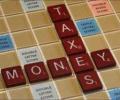
The government now ends its mandate with reaffirmation in the vote-on-account of the same goals, for which it claims to have a clear line of sight.
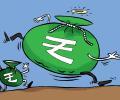
Shares of asset management companies (AMCs) have rallied in the last 3-4 sessions due to clarity on regulatory changes in total expense ratios (TER) and expectations that it won't upset profits much in the long run. HDFC AMC has gained over 12 per cent in the last four sessions, while Nippon AMC and UTI AMC are up around 5 per cent. Aditya Birla Sun Life (ABSL), the only other listed AMCs, has risen more than 2.3 per cent in the last four sessions.

The government may be staring at a modest slippage in fiscal deficit for 2022-23 (FY23), with the Ministry of Finance seeking parliamentary approval for additional spending through a second and final tranche of supplementary demands for grants. On Monday, as the Budget session of Parliament resumed, Finance Minister Nirmala Sitharaman sought Parliament approval for additional gross spending of Rs 2.7 trillion in FY23 (which ends on March 31). While net cash outgo is pegged at Rs 1.48 trillion, the rest will be matched by savings or enhanced receipts, the finance ministry said.

'They would not have had to impose GST on wheat, rice, buttermilk etc. if they had not toppled governments. People do not have to face inflation'
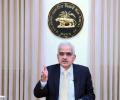
The challenge for the RBI in 2024 is likely to be less about containing elevated inflation and more about curbing excessive financial market exuberance and a 'problem of plenty', notes Sajjid Chinoy, Chief India Economist JP Morgan.
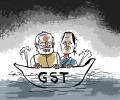
'Because of the COVID-19 pandemic situation today, the revenues of the states have gone down, the GST money is not coming and all the states combined have lost more than Rs 365,000 crore in revenue.' 'To make it worse, the Government of India is not compensating us for the shortfall, which it must as per its Constitutional obligations.'

'Modi had not discussed demonetization with me prior to his announcement on 8 November 2016. 'I learnt of it along with the rest of the country. 'I was not surprised when he did not discuss the issue with me prior to making the public announcement. 'It fitted in with his style of making dramatic announcements.' A fascinating excerpt from Pranab Mukherjee's The Presidential Years: 2012-2017.

L&T is the preferred pick, but given the opportunities in the power T&D space analysts are also positive on KEC, ABB and Kalpataru

The demand has gradually shifted from 16-tonners to 25-tonners and is further shifting in favour of 31-t and 37-t trucks.
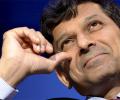
Reserve Bank of India (RBI) Governor Raghuram Rajan spoke on a host of issues at his last post-policy interaction with the media
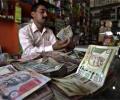
Amendments to RBI Act likely soon
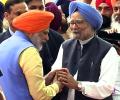
Whether it was the MGNREGS or the NFSA or the Aadhaar-based DBT scheme for cash transfer, the Modi government has built on the basic architecture created by the Singh government. Policy makers in the Modi government, instead of discarding them as products of the previous political regime, worked on them, expanded their scope and reach, and used new tools to improve their performance, explains A K Bhattacharya.

'You may see some movement indicating a simpler tax regime with less exemptions but with fewer tax rates making life simpler for taxpayers.'

The government expects indirect tax collection to be lower than the Budget Estimate (BE) of Rs 13.38 trillion this fiscal year, despite prospects of netting goods and services tax (GST) in large amounts, Revenue Secretary Tarun Bajaj has said. "Indirect tax collection may see lower realisation than budgeted on account of cuts in excise and customs duties. "We could see a shortfall of about Rs 1.5 trillion on account of those," he told Business Standard.
Arun Jaitley said he would put the DTC Bill in cold storage.

In the face of tax blow, brokerages remain sanguine about the prospects of asset management companies (AMCs). A sharp correction in the shares of AMCs over the past three months factors in most of the negatives and turned valuations attractive, observe analysts. In its latest report, Kotak Institutional Equities (KIE) has upgraded HDFC AMC to 'add' (from 'reduce') and reprised 'add' and 'buy' ratings on the rest of the listed AMCs - Nippon, UTI, and Aditya Birla Sun Life.
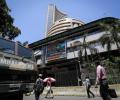
The 50-share NSE Nifty reclaimed the key 9,900-mark in day trade but profit-booking at higher levels trimmed its gains. The index settled at 9,884.40.

She has shown shrewdness, sensitivity, and courage. All of these will be needed in ample quantities for the real challenge that will emerge after the elections, notes Shreekant Sambrani.

The cement sector may be looking at better realisations and higher volume offtake going by the trends of the October-December quarter of the 2022-23 financial year (Q3FY23), a recent price hike, and the promise of a continued infrastructure thrust in FY24. In Q3, revenues rose by an aggregate of 17 per cent year-on-year (YoY), but Ebitda (earnings before interest, tax, depreciation and amortisation) per tonne, fell by 14 per cent YoY while profit after tax (PAT) rose by 23 per cent YoY. Expenses were up 30 per cent per tonne YoY - power and fuel costs in particular - and that's no surprise given the rise in fossil fuel prices.

The central government is on track to meet its fiscal deficit target of 6.4 per cent of the GDP for 2022-23 on the back of strong growth in revenue collections, the World Bank said in its India Development Update on Tuesday. High nominal GDP growth in the first quarter supported strong growth in revenue collection, especially Goods and Services Tax (GST), despite tax cuts on fuel. Notwithstanding an increase in spending due to expanded fertilizer subsidies and food subsidies for vulnerable households in response to the commodity price shock, the government is on track to meet its FY22/23 fiscal deficit target of 6.4 per cent of GDP and the general government deficit is projected to decline to 9.6 per cent from 10.3 per cent in FY21/22 and 13.3 per cent in FY20/21.

At present, bank depositors get an insurance cover of Rs 1 lakh on their amount by the Deposit Insurance and credit Guarantee Corporation.
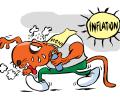
Don't be surprised if growth in the second half of the financial year drops below 4%, which is where it was in the year before the pandemic, warns T N Ninan.
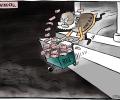
When emerging from this crisis, the govt must consider a fresh approach to reviving growth, revisiting the Centre-state fiscal balance, and devising a re-imagined GST 2.0, suggests T N Ninan.

'If somebody compares Mumbai with the Taliban and PoK, then that person is anti-national.'
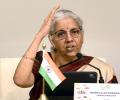
'I'm pitching India for the strengths we offer, including the English language, engineers, doctors, nurses, professionals, innovative talent of startups.'

In a rare face off, captains of the auto industry have hit out at the government for not walking the talk. At an industry event in the capital on Wednesday, R C Bhargava, chairman of India's largest carmaker Maruti Suzuki, and Venu Srinivasan, chairman of TVS Motor, questioned the government's intent to support the auto sector. Revenue secretary Tarun Bajaj sat in the audience listening, before his turn came to counter them.

With the first quarter gross tax mop-up reaching Rs 5.6 lakh crore, Icra Ratings on Friday said the government is set to exceed the budgeted tax collection target of Rs 22.2 lakh crore for 2021-22, led by indirect taxes. The government has budgeted a modest 9.5 per cent growth in tax collections at Rs 22.2 lakh crore for FY22, over FY21 collections of Rs 20.2 lakh crore. However, despite the second wave of the pandemic, the April-June quarter tax collections rose to Rs 5.6 lakh crore, which is 39 per cent higher than Q1 of FY20.
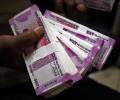
The budgeted indirect tax collection target is Rs 9.26 trillion, and the Centre has collected around Rs 5 trillion in the first 8 months. So it needs another Rs 4.2 trn in the last four months
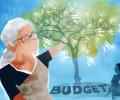
Finance Minister Nirmala Sitharaman will present the Union Budget for 2023-24 in Parliament on February 1. The Budget is a statement of the government's estimated receipts and expenditures for a fiscal year (April 1 to March 31). It's divided into Revenue and Capital Budget. The Revenue Budget includes the government's revenue receipts and expenditures while the Capital Budget includes its capital receipts and payments.

The Asian markets are largely trading in the green, taking heart from a positive close on Wall Street.

Union Finance Minister Nirmala Sitharaman on Friday said the Indian economy is on a sustained path of revival and cited rise in GST collections and direct taxes to support her assertion. She further said that the confidence in the Indian stock market is growing as retail and small investors are keenly investing money in the share market. She was addressing the media in New Delhi.

E-way bill generation, which is related to paying Goods and Services Tax (GST) and a key high-frequency indicator of economic activity, may have fallen to a five-month low in April as more cities experience lockdowns due to a surge in Covid-19 cases. In April e-way bill generation may decline to 55-58 million, which is the lowest since at least November. On the higher side, it is a 17 per cent decline over March.
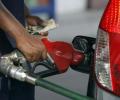
Higher oil prices, while not having an impact on Centre's revenues due to fixed tax rate, are pushing up states' sales tax revenue.
While presenting her 2021-22 Union Budget, Finance Minister Nirmala Sitharaman had set a fiscal deficit target of 6.8 per cent of nominal gross domestic product (GDP) against the 2020-21 Revised Estimate of 9.5 per cent. The fiscal correction in the upcoming 2022-23 Union Budget is unlikely to be that steep. Even as discussions among top Budget-makers are ongoing, the fiscal deficit target for 2022-23 may likely be in the range of 6.5-6.8 per cent.

The proposal may provide relief to the tune of Rs 9,000 crore to service providers.
The Centre and states are likely to budget for higher market borrowings to the tune of Rs 2.3 lakh crore next fiscal even though the Union budget may peg a lower-than-expected fiscal deficit for the Centre at 5.8 per cent of GDP, says a report. Icra Ratings anticipates higher redemptions will lead to gross market borrowings of the Centre to rise to Rs 14.8 lakh crore and of the states to jump by Rs 1.6 lakh crore to Rs 9.6 lakh crore, taking the combined borrowings (of the Centre and the states) to Rs 24.4 lakh crore in FY2024, up by 2.3 lakh crore from FY23 combined. In FY23, the Centre's gross borrowings are budgeted at Rs 14.1 lakh crore and of the states at Rs 8 lakh crore, or a combined borrowing of Rs 22.1 lakh crore, according to the agency.
The banking sector emerged as an outlier when the rest of India Inc witnessed a slowdown in earnings in FY23. The combined net profit of listed public and private sector banks was up 39.4 per cent year-on-year (YoY) last financial year and their share in India's gross value added (GVA) or gross domestic product (GDP) at factor cost rose to a record high of nearly 1 per cent up, from 0.8 per cent a year ago. Listed banks' combined net profit grew to Rs 2.36 trillion in FY23, from Rs 1.69 trillion a year ago. In comparison, India GVA at current prices was up 15.2 per cent YoY at Rs 247 trillion in FY23; it was around Rs 214 trillion a year ago.

Fair trade regulator CCI on Thursday alleged that Google has created a digital data hegemony and called for a market space with "free, fair and open competition". Concluding the arguments of the Competition Commission of India (CCI) before the appellate tribunal NCLAT in the Google matter, Additional Solicitor General N Venkataraman said a market with greater freedom for all players would be in total sync with principles of free competition rather than the 'walled garden' approach of the internet major. On October 20 last year, the CCI slapped a penalty of Rs 1,337.76 crore on Google for anti-competitive practices in relation to Android mobile devices.

This meeting has led to the deferment of the Goods and Services Tax (GST) Council meeting by a day.

The cigarettes segment had a revenue of Rs 4,554.21 crore during the second quarter of the current fiscal, as against Rs 8,528.47 crore in the year-ago period, down 46.56 per cent.
